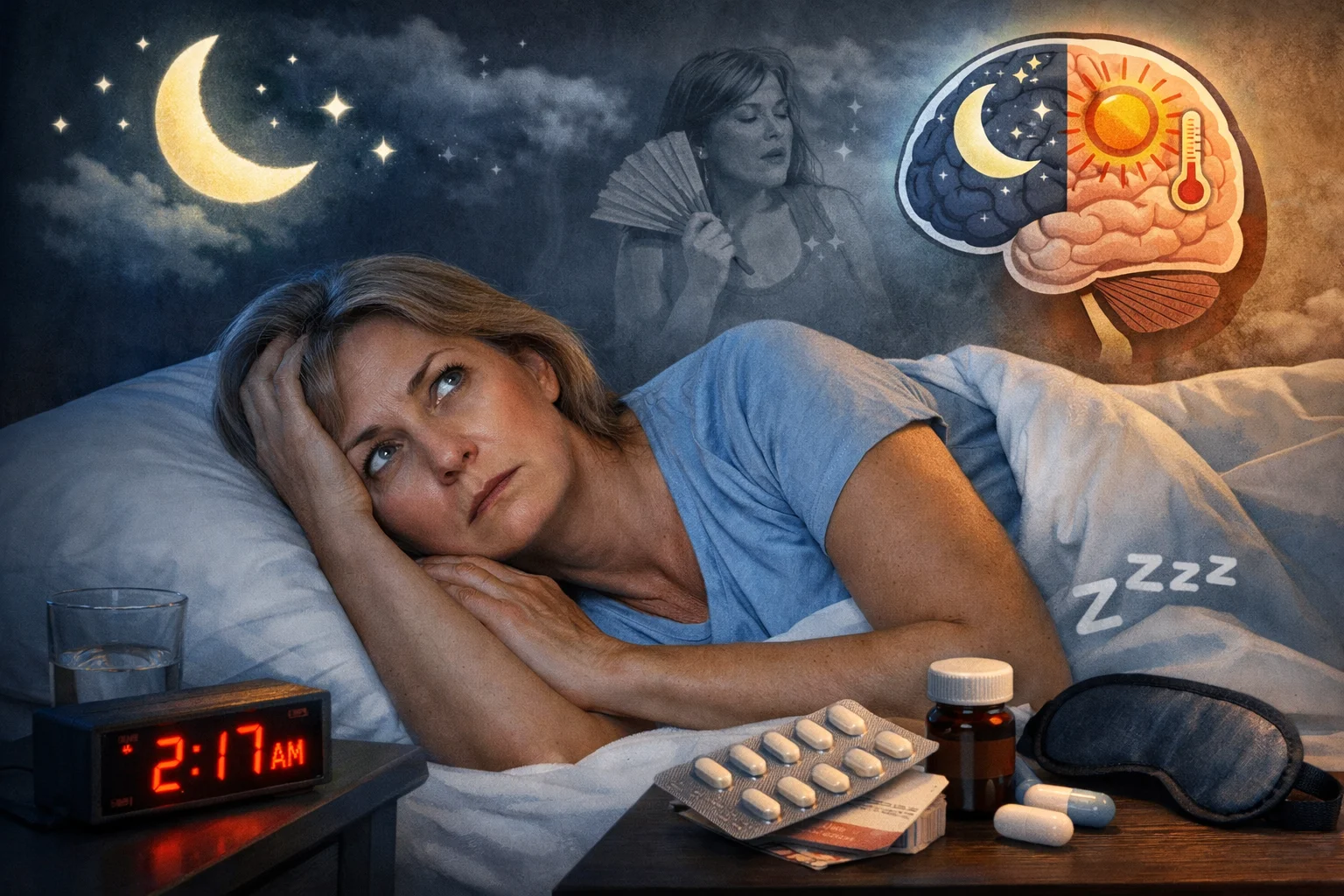
You lie down. You are tired. You close your eyes.
And then nothing happens.
Or worse, you fall asleep fine, only to wake up at 2 in the morning, completely alert, heart racing, sheets damp from a night sweat. You stare at the ceiling for an hour. You finally drift off. The alarm goes off 45 minutes later.
If this sounds familiar, you are not alone. Sleep disruption is one of the most common and most exhausting symptoms of perimenopause and menopause. Many women reach a point where they start wondering whether a sleep medication might just give them their nights back.
It is a fair question. This article answers it honestly, including what experts actually recommend, what the risks are, and what tends to work better in the long run.
Why Does Menopause Cause Insomnia?
Sleep problems during menopause are not a matter of stress or lifestyle alone. They have a direct hormonal cause.
Two hormones are at the centre of it. The first is estrogen. It plays a role in regulating body temperature, supporting serotonin production, and maintaining healthy REM sleep cycles. As estrogen declines during perimenopause and menopause, all three of these functions become less stable. You sleep lighter. You wake more easily. Your body temperature fluctuates overnight, which is what causes night sweats.
The second is progesterone. This hormone has a natural calming effect on the nervous system. It helps quiet the brain at night and supports the kind of deep, restorative sleep that leaves you feeling rested. As progesterone levels drop, that calming signal weakens. Falling asleep becomes harder. Staying asleep becomes harder still.
Together, these two hormonal shifts create the conditions for insomnia. It is not in your head. It is in your biology.
What Sleep Problems Are Common During Menopause?
The pattern looks different for different women, but the most commonly reported sleep problems include:
- Difficulty falling asleep, even when you feel physically tired
- Waking frequently through the night, often without an obvious reason
- Night sweats that pull you out of deep sleep
- Early morning waking, where you wake at 4 or 5 am and cannot go back to sleep
- Daytime fatigue that accumulates over weeks and affects mood, memory, and focus
For many women, it is not just one of these. It is several of them happening together, night after night. That combination is what makes menopause insomnia so draining.
Should You Take Sleep Medication?
This is where it gets nuanced. Sleep medications can help. But most experts recommend them with significant caution, and rarely as a first-line solution.
Here is why.
Sleep medications work by sedating the nervous system. They can help you fall asleep faster and stay asleep longer in the short term. But they do not address the underlying cause of menopause insomnia, which is hormonal. You are managing a symptom without treating the root. The moment you stop the medication, the insomnia tends to return.
Beyond that, long-term use of sleep medications carries real risks:
- Dependence, where the body relies on the drug to initiate sleep
- Daytime drowsiness and reduced concentration
- Memory problems, particularly with certain sedative-hypnotic drugs
- Reduced sleep quality over time, as the brain adapts to the medication and natural sleep architecture deteriorates
Most doctors will consider sleep medication only when insomnia is severe, significantly affecting daily functioning, and when other approaches have not been sufficient. Even then, it is usually intended as a short-term bridge, not a long-term solution.
Types of Sleep Medications Used During Menopause
If a doctor does recommend medication, the options typically fall into three categories.
Prescription sleep medications include sedative-hypnotics and certain low-dose antidepressants. Sedative-hypnotics work quickly and are effective for acute insomnia. Certain antidepressants are sometimes prescribed at low doses specifically for their sedating properties, particularly in women who are also experiencing mood changes alongside sleep disruption.
Over-the-counter sleep aids are widely available and often the first thing women try. Antihistamine-based options cause drowsiness but are generally not recommended for regular use. They lose effectiveness quickly and can cause significant next-day grogginess. Melatonin is a gentler option and works differently. It supports the body’s natural sleep-wake cycle rather than sedating the nervous system directly. It is particularly useful if your primary problem is falling asleep or if your sleep schedule has become irregular.
Hormone therapy addresses the root cause rather than just the symptom. By stabilising estrogen and progesterone levels, it can reduce night sweats, improve temperature regulation, and restore some of the hormonal conditions that support natural sleep. For women whose insomnia is primarily driven by night sweats or significant hormonal volatility, this is often the most effective approach. It is not suitable for everyone, and requires a careful assessment by a doctor.
Natural Remedies That Can Help
Many experts recommend trying evidence-informed natural approaches before turning to medication. They take longer to show results, but they work with your body rather than around it.
Melatonin is worth mentioning again here. At low doses, taken 30 to 60 minutes before bed, it can help signal to the brain that it is time to sleep. It is particularly useful during perimenopause when the body’s natural melatonin production begins to decline with age.
Magnesium is another option with growing evidence behind it. It supports muscle relaxation and calms the nervous system. Many women find that taking magnesium glycinate in the evening helps them fall asleep more easily and wake less frequently through the night.
Herbal supplements such as valerian root, chamomile, and ashwagandha have been used traditionally for sleep and anxiety. The evidence is mixed, but some women find them genuinely helpful as part of a broader sleep routine. Always check with a doctor before starting any supplement, especially if you are on other medications.
Lifestyle Changes That Make a Real Difference
The research on sleep hygiene is consistent. These are not small tweaks. Done properly, they can meaningfully reduce insomnia over time.
Keep a consistent sleep schedule. Going to bed and waking at the same time every day, including weekends, helps regulate your circadian rhythm. This is one of the most effective things you can do for sleep quality, and it costs nothing.
Cool your bedroom. Night sweats are significantly worsened by a warm sleeping environment. Lower the thermostat before bed. Use a fan. Switch to lighter, breathable bedding. Some women find that keeping a cold glass of water nearby helps them settle more quickly after a night sweat episode.
Cut off caffeine early. Caffeine has a half-life of around five to six hours in the body. A cup of coffee at 3 pm can still be affecting your brain at 9 pm. During perimenopause, when sleep is already fragile, afternoon caffeine is worth eliminating.
Reduce alcohol. Many women use a glass of wine to wind down, and it does help with falling asleep. But alcohol disrupts sleep architecture in the second half of the night. You fall asleep easily and then wake up at 3 am, unable to settle. The net effect is worse sleep, not better.
Limit screens before bed. Blue light from phones and laptops suppresses melatonin production. A simple habit of putting screens away 45 to 60 minutes before bed can support your body’s natural wind-down process.
CBT-I: The Most Effective Long-Term Treatment
If there is one approach that sleep experts consistently recommend above all others for chronic insomnia, it is Cognitive Behavioural Therapy for Insomnia, known as CBT-I.
CBT-I works by addressing the thoughts and behaviours that perpetuate insomnia. Many women develop a kind of sleep anxiety over time. They start dreading bedtime because they expect to lie awake. That dread itself activates the nervous system and makes sleep harder. CBT-I helps break that cycle.
It typically involves working with a therapist or a structured programme over several weeks. It addresses sleep restriction, stimulus control, relaxation techniques, and the cognitive patterns that keep the brain in a state of alertness at night.
Unlike medication, CBT-I treats the cause of chronic insomnia, not just the symptom. Studies consistently show it outperforms sleep medication in the long term. The results also last after the programme ends, which is not the case with most medications.
When to See a Doctor
Most sleep disruption during perimenopause can be meaningfully improved with the strategies above. But there are situations where a medical consultation is important:
- Insomnia has lasted more than several weeks and is not improving
- You are relying on sleep medication regularly and want to reduce dependence
- Night sweats are so severe that no environmental adjustment makes a difference
- Daytime fatigue is affecting your work, relationships, or safety
A doctor can assess whether hormone therapy is appropriate, screen for other contributing conditions such as thyroid imbalance or sleep apnoea, and help you build a treatment plan that is right for your specific situation.
Key Takeaways
- Menopause insomnia is caused by declining estrogen and progesterone, which destabilise temperature regulation, serotonin production, and the nervous system’s natural calming response
- Sleep medications can provide short-term relief but carry real risks with long-term use, including dependence, daytime drowsiness, and declining sleep quality
- Natural options including melatonin, magnesium, and herbal supplements can support sleep without the risks associated with prescription drugs
- Lifestyle changes, particularly a consistent sleep schedule, a cool bedroom, and cutting caffeine and alcohol, are among the most effective and sustainable interventions
- CBT-I is considered the gold standard for treating chronic insomnia and works better than medication in the long term
- Hormone therapy addresses the root hormonal cause and may be the most effective option for women whose insomnia is closely tied to night sweats and hormonal volatility
Resources
- National Institute on Aging. Sleep Problems and Menopause: What Can I Do? https://www.nia.nih.gov/health/menopause/sleep-problems-and-menopause-what-can-i-do
- The Menopause Society. Sleep Disturbance at Menopause. https://www.menopause.org/publications/clinical-care-recommendations
- American Academy of Sleep Medicine. Cognitive Behavioral Therapy for Insomnia. https://aasm.org
- Mayo Clinic. Insomnia. https://www.mayoclinic.org/diseases-conditions/insomnia/symptoms-causes/syc-20355167