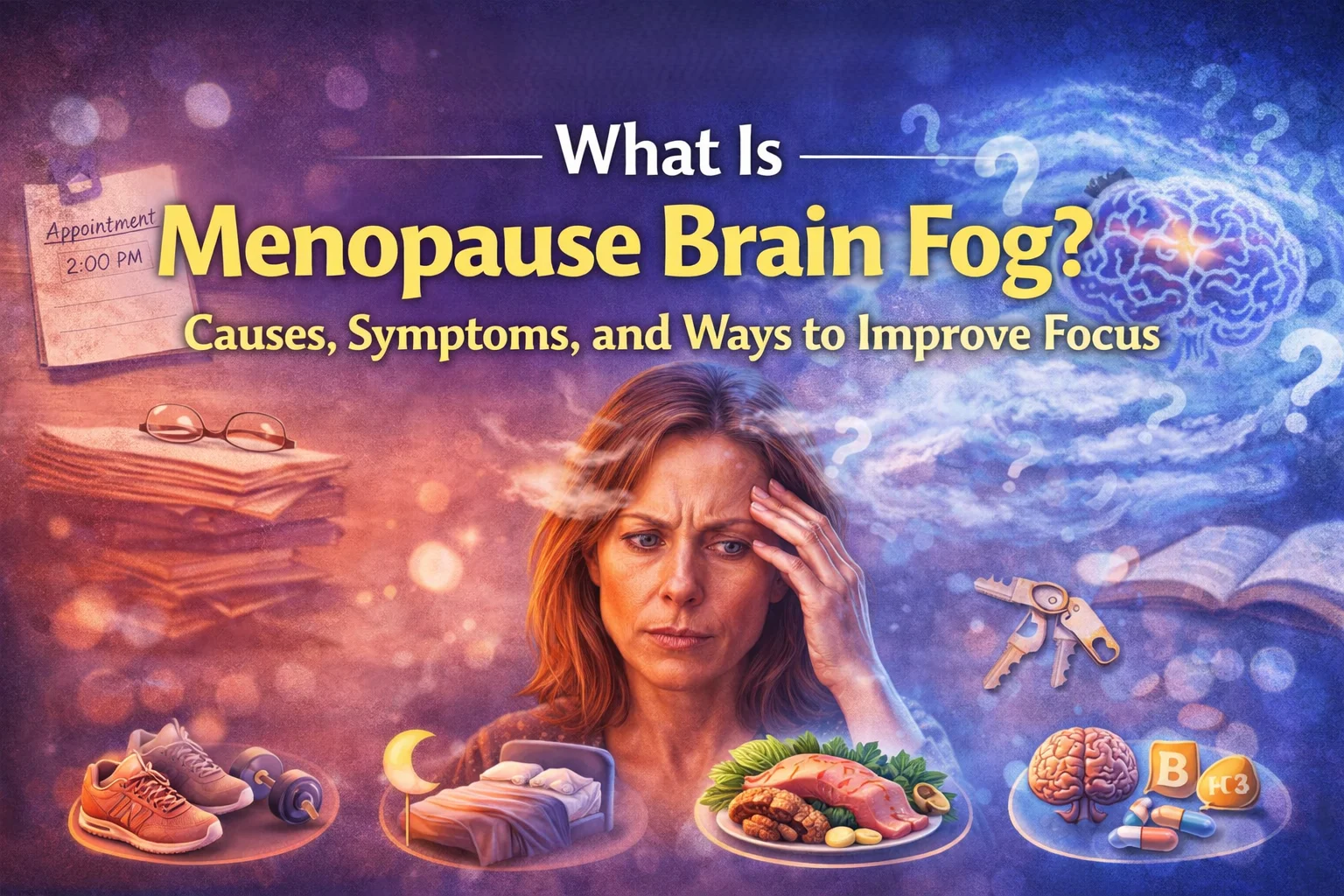
You walk into the kitchen and stand there, completely blank. You cannot remember why you came in.
You are mid-sentence in a conversation and the word you need just disappears. You know you know it. But it is gone.
You read the same paragraph three times and still cannot absorb what it says.
If this is starting to sound familiar, you are not losing your mind. You are likely experiencing what is commonly called menopause brain fog. It is one of the most unsettling symptoms of perimenopause and menopause, partly because it is so hard to explain to someone who has not felt it. And partly because it makes you question yourself in a way that other symptoms do not.
The good news is that it is real, it is recognised, it has a clear biological cause, and for most women, it improves with time.
What Is Menopause Brain Fog?
Menopause brain fog is not a medical diagnosis. It is a term used to describe a cluster of temporary cognitive difficulties that many women experience during perimenopause and menopause.
It is not dementia. It is not a sign of permanent cognitive decline. It is a hormonal disruption affecting the way the brain processes and retrieves information during a specific phase of life.
Women describe it in different ways. Some say their thinking feels slower than usual. Others describe it as mental fatigue, like the brain is working twice as hard to do the same tasks. Some notice they are more forgetful. Others struggle to concentrate for extended periods or find themselves losing their train of thought mid-conversation.
Common experiences include:
- Forgetfulness, such as misplacing things or forgetting appointments
- Difficulty concentrating, especially on tasks that require sustained focus
- Trouble finding words during conversation
- Slower mental processing, where thinking feels effortful rather than automatic
- Mental fatigue that does not resolve with rest
- Losing your train of thought more easily than before
These symptoms tend to be mild to moderate for most women. But even mild cognitive changes can feel alarming when they are happening to you, especially if you have always been sharp and organised.
Why Does Brain Fog Happen During Menopause?
The answer, as with so many menopause symptoms, comes down to estrogen.
Estrogen is not just a reproductive hormone. It plays an active and important role in brain function. It supports the production and regulation of several key neurotransmitters, including serotonin, which affects mood and cognition, dopamine, which supports motivation and mental sharpness, and acetylcholine, which is directly involved in memory formation and recall.
Estrogen also supports the brain’s energy metabolism. It helps brain cells use glucose efficiently. When estrogen levels decline or fluctuate during perimenopause, the brain is essentially receiving less of the chemical support it has relied on for decades.
The result is a temporary shift in how clearly and efficiently the brain functions. Think of it like a busy office that suddenly loses half its administrative staff. The work still gets done. But it takes more effort, more time, and there are more moments where things slip through.
Beyond estrogen, two other factors compound the problem significantly.
Poor sleep is one of the biggest drivers of cognitive symptoms during menopause. Night sweats and insomnia reduce both the quantity and quality of sleep. Deep sleep is when the brain consolidates memories and clears metabolic waste. When that process is repeatedly interrupted, cognitive performance suffers noticeably the next day and over time.
Stress and anxiety, which are common during this phase of life, also directly impair memory and concentration. Chronic stress keeps the brain in a state of low-level alert, which diverts resources away from higher cognitive functions like focus, recall, and clear thinking.
When Does Brain Fog Begin?
Brain fog does not wait for menopause. For many women, it begins during perimenopause, the transitional phase that can start in the mid-40s.
During perimenopause, estrogen levels do not decline smoothly. They fluctuate wildly. One week they are relatively high. The next week they drop sharply. This hormonal volatility is particularly disruptive to brain chemistry, because the brain is constantly adjusting to a moving target rather than a stable baseline.
This is also the phase when sleep disruption tends to be most significant. More night sweats, more insomnia, more early morning waking. All of which accelerate cognitive fatigue.
Many women going through perimenopause describe this period as cognitively the most challenging, precisely because the hormonal fluctuations are at their most unpredictable.
What Makes Brain Fog Worse?
Several factors can amplify cognitive symptoms beyond the hormonal baseline.
Nutritional deficiencies are worth paying attention to. Low levels of vitamin B12 can cause memory difficulties and mental fatigue that closely mimic brain fog. Iron deficiency reduces oxygen delivery to the brain. Low magnesium affects nervous system function and sleep quality. Many women in midlife are mildly deficient in one or more of these, particularly if diet has not been a focus.
Alcohol impairs memory consolidation and sleep architecture. Even moderate drinking can noticeably worsen brain fog the following day, and regular drinking compounds the effect over time.
Sedentary lifestyle reduces blood flow to the brain and slows the production of brain-derived neurotrophic factor (BDNF), a protein that supports the growth and maintenance of brain cells. Women who are physically active consistently report better cognitive function during menopause than those who are not.
Mood changes, including depression and anxiety, which are themselves common during perimenopause, have a direct and well-documented impact on concentration, memory, and mental clarity. Brain fog and low mood often reinforce each other, creating a cycle that is harder to break if only one is addressed.
Does Menopause Brain Fog Go Away?
For most women, yes.
Brain fog tends to improve as the body moves through menopause and hormonal levels settle into a new, more stable baseline. The postmenopause phase, once the transition is complete, is often when cognitive symptoms begin to ease noticeably.
The timeline varies. Some women find clarity returns relatively quickly. Others find it takes a few years. What is consistent across the research is that menopause brain fog is not permanent for the vast majority of women. It is a phase, not a fixture.
That said, the lifestyle factors above matter. Women who sleep well, exercise regularly, manage stress, and eat a nutrient-rich diet consistently report better cognitive outcomes during and after this transition.
Natural Ways to Improve Focus and Mental Clarity
Exercise regularly. This is the single most evidence-backed intervention for cognitive health during menopause. Physical activity increases blood flow to the brain, stimulates the production of BDNF, improves mood, and supports better sleep. All four of these effects directly benefit cognitive function. Even a brisk 30-minute walk each day makes a measurable difference over time.
Prioritise sleep. Brain fog and poor sleep are deeply connected. Addressing night sweats and insomnia, through the strategies covered in our sleep articles, is one of the most direct ways to improve cognitive clarity. The brain simply cannot function well without consistent, restorative sleep.
Eat for brain health. Certain nutrients are particularly important during this phase:
- Omega-3 fatty acids from fatty fish, walnuts, and flaxseeds support brain cell structure and reduce inflammation
- B vitamins, especially B12 and folate, are essential for neurological function and energy metabolism
- Antioxidant-rich foods such as berries, leafy greens, and nuts protect brain cells from oxidative stress
- Whole grains keep blood sugar stable, which directly supports sustained concentration
Manage stress deliberately. A nervous system that is constantly activated cannot think clearly. Mindfulness meditation, breathing exercises, and gentle yoga all help shift the brain out of high-alert mode and into a state more conducive to clear thinking. Even 10 minutes of intentional stillness each day has measurable cognitive benefits.
Stay mentally active. The brain responds to stimulation. Reading, learning something new, doing puzzles, picking up a creative hobby, even having substantive conversations all help maintain cognitive sharpness. The brain is not a muscle, but it does respond to being used.
Reduce alcohol. The connection between alcohol and brain fog is direct and well documented. Reducing intake, particularly in the evening, can produce noticeable improvements in mental clarity within a few weeks.
Supplements That May Support Brain Health
Some supplements have evidence behind them for cognitive support during menopause.
Omega-3 fatty acids (EPA and DHA) support brain cell membrane integrity and have been associated with better cognitive performance and lower rates of cognitive decline.
Vitamin B complex addresses potential deficiencies in B6, B9, and B12, all of which are important for neurological function and energy metabolism.
Magnesium glycinate supports sleep quality and nervous system regulation. Since poor sleep is one of the biggest drivers of brain fog, improving sleep through magnesium has an indirect but meaningful cognitive benefit.
Ginkgo biloba has been studied for its effects on memory and circulation to the brain. Evidence is mixed, but some women find it helpful as part of a broader approach.
Always speak to a doctor before starting any supplement, particularly if you are on other medications or managing any health conditions.
Medical Treatments for Severe Brain Fog
Hormone therapy may help some women whose brain fog is closely tied to severe hormonal fluctuation. By stabilising estrogen levels, it can restore some of the brain’s chemical support systems. It is not a universal solution, and requires a personalised assessment. But for women whose cognitive symptoms are significantly affecting their quality of life, it is worth discussing.
Cognitive therapy and structured mental training programmes are increasingly available and can help women develop strategies for managing memory difficulties and improving concentration during this phase.
If brain fog is accompanied by significant mood changes, a doctor may also explore whether low-level depression or anxiety is contributing and whether that warrants its own treatment.
When to See a Doctor
Most menopause brain fog is temporary and manageable. But there are times when medical advice is important:
- Cognitive symptoms are severe and worsening over time rather than fluctuating
- Memory problems are affecting your work, safety, or ability to manage daily responsibilities
- Brain fog is accompanied by significant depression, anxiety, or mood changes
- You are concerned and want to rule out other neurological causes
A doctor can assess your full picture, screen for other contributing factors, and discuss appropriate options.
Key Takeaways
- Menopause brain fog is a temporary cluster of cognitive symptoms including forgetfulness, difficulty concentrating, slower thinking, and mental fatigue
- It is caused by declining and fluctuating estrogen, which directly affects neurotransmitters, brain energy metabolism, and sleep quality
- Poor sleep, chronic stress, nutritional deficiencies, and alcohol all amplify cognitive symptoms beyond the hormonal baseline
- For most women, brain fog improves as hormone levels stabilise in postmenopause. It is not permanent
- Regular exercise, restorative sleep, a nutrient-rich diet, and consistent stress management are the most effective natural interventions
- Supplements including omega-3s, B vitamins, and magnesium may support cognitive function alongside lifestyle changes
- Hormone therapy is an option for women whose symptoms are severe and significantly affecting daily life
Resources
- Mayo Clinic. Menopause. https://www.mayoclinic.org/diseases-conditions/menopause/symptoms-causes/syc-20353397
- National Institute on Aging. Cognitive Health and Older Adults. https://www.nia.nih.gov/health/brain-health/cognitive-health-and-older-adults
- The Menopause Society. Cognition, Mood, and Menopause. https://www.menopause.org/publications/clinical-care-recommendations
- Harvard Health Publishing. Menopause and Memory. https://www.health.harvard.edu/mind-and-mood/menopause-and-memory